



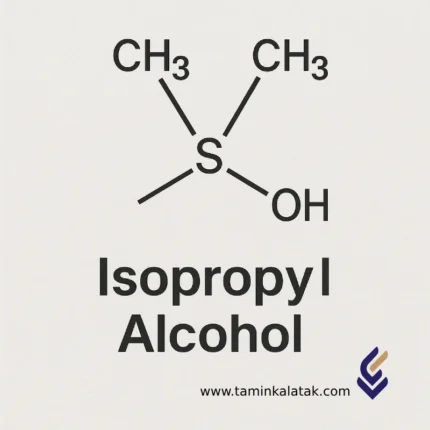
Isopropyl Alcohol
Isopropyl Alcohol (Isopropanol or 2-Propanol) is an organic compound from the alcohol family with the chemical formula C₃H₈O or CH₃CHOHCH₃. It is classified as a secondary alcohol and appears as a volatile, flammable, colorless liquid with a strong, characteristic odor.
Due to its antiseptic properties, high solvency, rapid evaporation, and compatibility with various substances, isopropyl alcohol is widely used across medical, hygienic, pharmaceutical, cosmetic, chemical, electronic, and printing industries.
Chemical Structure of Isopropyl Alcohol
-
Molecular formula: C₃H₈O
-
IUPAC name: Propan-2-ol
-
Structural formula: CH₃–CHOH–CH₃
-
Type of alcohol: Secondary alcohol
-
Molecular weight: 60.10 g/mol
The hydroxyl group (–OH) in this compound is attached to the second carbon atom, distinguishing it from other simple alcohols such as ethanol or 1-propanol (n-propanol).
Physical and Chemical Properties
Isopropyl alcohol possesses a set of physical and chemical properties that make it particularly suitable for industrial and medical use:
| Property | Description |
|---|---|
| Odor | Sharp, alcoholic, characteristic |
| Boiling point | 82.6 °C |
| Flash point | 12 °C – highly flammable |
| Refractive index (20 °C) | 1.377 |
| Common grades | 70% (medical), 99% (industrial, laboratory) |
| pH (aqueous solution) | Neutral to slightly acidic (~6) |
Applications of Isopropyl Alcohol
1. Medical and Disinfection Uses
-
Used as a disinfectant for skin, hands, medical instruments, and hard surfaces before injections or surgeries
-
Formulated in alcohol swabs, sanitizing sprays, hand gels, and skin prep solutions
-
Effective against a broad spectrum of bacteria, viruses, and fungi at concentrations of 60–80%
2. Cosmetics and Personal Care
-
Serves as a solvent base in toners, makeup removers, aftershaves, body sprays, and perfumes
-
Provides fast-drying properties without oily residue
-
Helps regulate viscosity and enhance microbial stability in formulations
3. Electronics and Optics
-
Functions as a residue-free cleaner for electronic boards, chips, connectors, and precision instruments
-
Cleans optical lenses, sensors, and glass surfaces
-
Removes grease, oil, and dust without water
4. Laboratory and Chemical Synthesis
-
Acts as a universal solvent in organic reactions, solution preparation, and laboratory glassware cleaning
-
Used as an intermediate in the synthesis of pharmaceuticals, cosmetics, and fragrances
-
Serves as a drying agent in sample preparation for microscopy
5. Printing and Ink Industry
-
Functions as a co-solvent in printing inks and solvent-based formulations
-
Enhances ink evaporation rate for quick drying and reduced smudging
-
Adjusts viscosity and improves adhesion to print surfaces
Industries Utilizing Isopropyl Alcohol
-
Electronics Industry
-
Cosmetics and Personal Care
-
Medical and Healthcare Sector
-
Chemical Manufacturing
-
Printing and Packaging
-
Pharmaceutical Industry
Advantages of Isopropyl Alcohol
-
Rapid evaporation without leaving grease or residue
-
Excellent solvent power for a wide range of organic and inorganic compounds
-
Antibacterial, antiviral, and antifungal activity at appropriate concentrations
-
Effective as both diluted (70%) and pure (99%) solutions
-
Compatible with materials such as glass, metals, ceramics, and many plastics
-
Non-corrosive under most conditions
-
Chemically stable under normal storage conditions
Disadvantages of Isopropyl Alcohol
-
Highly flammable – must be stored in sealed containers, away from heat sources and with proper ventilation
-
Inhalation of vapors may cause headache, dizziness, respiratory irritation, or nausea
-
Repeated skin contact may result in dryness, itching, or mild irritation
-
Incompatible with strong oxidizing agents (e.g., permanganates, peroxides)
-
Not suitable for ingestion or injection – improper use can be toxic and dangerous
Safety and Storage of Isopropyl Alcohol
Isopropyl alcohol (C₃H₈O) is one of the most commonly used solvents in pharmaceutical, cosmetic, hygienic, and chemical industries. However, despite its extensive use, strict safety and storage measures are required to ensure safe handling.
Safety Guidelines:
-
Highly flammable; its vapors can form explosive mixtures with air
-
Avoid working near open flames, sparks, or heat sources
-
May cause mild to moderate irritation upon skin or eye contact; prolonged exposure can dry out the skin
-
Inhalation in poorly ventilated spaces may lead to headache, dizziness, or nausea
Storage Conditions:
-
Store in tightly sealed metal or chemical-resistant plastic containers with proper labeling
-
Keep in a cool, dry, well-ventilated area, away from direct sunlight
-
Avoid exposure to oxidizing agents, heat, and open flames
-
Maintain in shaded environments to ensure product stability and safety

Ketone Solvents
In organic chemistry, a ketone is an organic compound with the structure R₂C=O, where R can be a variety of carbon-containing substituents. Combined with other functional groups, ketone and aldehydes are widespread in nature. They are also known as methanoyl or formyl group, and are very common and essential in biology and industry.
Methyl isobutyl ketone (MIBK) is produced on an industrial scale by treating acetone with a strongly acidic, palladium catalyst-doped cation exchange resin under medium pressure of hydrogen. It is a common solvent used in various industries, including paints and coatings, adhesives, and pharmaceuticals. MIBK is a stable and versatile solvent that can dissolve a wide range of substances, including resins, oils, and waxes. In the paint and coatings industry, MIBK is used as a solvent for nitrocellulose, vinyl resins, and acrylic resins.
- Chemical intermediaries
- , extraction of rare metals
- food additives
Kojic acid
Lorem ipsum dolor sit amet, consectetur adipiscing elit. Vestibulum sagittis orci ac odio dictum tincidunt. Donec ut metus leo. Class aptent taciti sociosqu ad litora torquent per conubia nostra, per inceptos himenaeos. Sed luctus, dui eu sagittis sodales, nulla nibh sagittis augue, vel porttitor diam enim non metus. Vestibulum aliquam augue neque. Phasellus tincidunt odio eget ullamcorper efficitur. Cras placerat ut turpis pellentesque vulputate. Nam sed consequat tortor. Curabitur finibus sapien dolor. Ut eleifend tellus nec erat pulvinar dignissim. Nam non arcu purus. Vivamus et massa massa.
Lactic acid
Lorem ipsum dolor sit amet, consectetur adipiscing elit. Vestibulum sagittis orci ac odio dictum tincidunt. Donec ut metus leo. Class aptent taciti sociosqu ad litora torquent per conubia nostra, per inceptos himenaeos. Sed luctus, dui eu sagittis sodales, nulla nibh sagittis augue, vel porttitor diam enim non metus. Vestibulum aliquam augue neque. Phasellus tincidunt odio eget ullamcorper efficitur. Cras placerat ut turpis pellentesque vulputate. Nam sed consequat tortor. Curabitur finibus sapien dolor. Ut eleifend tellus nec erat pulvinar dignissim. Nam non arcu purus. Vivamus et massa massa.
Lart 8
Lorem ipsum dolor sit amet, consectetur adipiscing elit. Vestibulum sagittis orci ac odio dictum tincidunt. Donec ut metus leo. Class aptent taciti sociosqu ad litora torquent per conubia nostra, per inceptos himenaeos. Sed luctus, dui eu sagittis sodales, nulla nibh sagittis augue, vel porttitor diam enim non metus. Vestibulum aliquam augue neque. Phasellus tincidunt odio eget ullamcorper efficitur. Cras placerat ut turpis pellentesque vulputate. Nam sed consequat tortor. Curabitur finibus sapien dolor. Ut eleifend tellus nec erat pulvinar dignissim. Nam non arcu purus. Vivamus et massa massa.
Latex Dipped Products Machinery
Lorem ipsum dolor sit amet, consectetur adipiscing elit. Vestibulum sagittis orci ac odio dictum tincidunt. Donec ut metus leo. Class aptent taciti sociosqu ad litora torquent per conubia nostra, per inceptos himenaeos. Sed luctus, dui eu sagittis sodales, nulla nibh sagittis augue, vel porttitor diam enim non metus. Vestibulum aliquam augue neque. Phasellus tincidunt odio eget ullamcorper efficitur. Cras placerat ut turpis pellentesque vulputate. Nam sed consequat tortor. Curabitur finibus sapien dolor. Ut eleifend tellus nec erat pulvinar dignissim. Nam non arcu purus. Vivamus et massa massa.
Latex Extruded Products Machinery
Lorem ipsum dolor sit amet, consectetur adipiscing elit. Vestibulum sagittis orci ac odio dictum tincidunt. Donec ut metus leo. Class aptent taciti sociosqu ad litora torquent per conubia nostra, per inceptos himenaeos. Sed luctus, dui eu sagittis sodales, nulla nibh sagittis augue, vel porttitor diam enim non metus. Vestibulum aliquam augue neque. Phasellus tincidunt odio eget ullamcorper efficitur. Cras placerat ut turpis pellentesque vulputate. Nam sed consequat tortor. Curabitur finibus sapien dolor. Ut eleifend tellus nec erat pulvinar dignissim. Nam non arcu purus. Vivamus et massa massa.
Latex Foam Processing Machine
Lorem ipsum dolor sit amet, consectetur adipiscing elit. Vestibulum sagittis orci ac odio dictum tincidunt. Donec ut metus leo. Class aptent taciti sociosqu ad litora torquent per conubia nostra, per inceptos himenaeos. Sed luctus, dui eu sagittis sodales, nulla nibh sagittis augue, vel porttitor diam enim non metus. Vestibulum aliquam augue neque. Phasellus tincidunt odio eget ullamcorper efficitur. Cras placerat ut turpis pellentesque vulputate. Nam sed consequat tortor. Curabitur finibus sapien dolor. Ut eleifend tellus nec erat pulvinar dignissim. Nam non arcu purus. Vivamus et massa massa.
Latex Processing Machinery
Lorem ipsum dolor sit amet, consectetur adipiscing elit. Vestibulum sagittis orci ac odio dictum tincidunt. Donec ut metus leo. Class aptent taciti sociosqu ad litora torquent per conubia nostra, per inceptos himenaeos. Sed luctus, dui eu sagittis sodales, nulla nibh sagittis augue, vel porttitor diam enim non metus. Vestibulum aliquam augue neque. Phasellus tincidunt odio eget ullamcorper efficitur. Cras placerat ut turpis pellentesque vulputate. Nam sed consequat tortor. Curabitur finibus sapien dolor. Ut eleifend tellus nec erat pulvinar dignissim. Nam non arcu purus. Vivamus et massa massa.
Latex Reclaimed Rubber
Latex Reclaimed Rubber that is produced from recycling natural rubber products made from the sap of the rubber tree. This material has a wide range of applications in various industries due to its unique properties.
Applications of recycled natural rubberAutomotive industry: production of gaskets, seat covers, engine parts and hoses. Construction industry: production of insulation, coatings and sealants. Consumer goods industry: production of toys, household appliances and sporting goods. Shoe industry: production of shoe soles and uppers.
Advantages of using recycled natural rubberCost reduction: Using recycled materials reduces production costs. Environmental protection: Reduction of rubber waste and reduction of raw material consumption. Suitable mechanical properties: It has good mechanical properties and can replace virgin natural rubber in many applications. Recyclability: This material can also be recycled.
Laureth-4
Laureth-4 or lauryl alcohol ethoxylate 4 is an anionic surfactant widely used in the cosmetics and detergent industries.
Features of Laureth-4Emulsifier: Helps to combine two immiscible substances such as oil and water. Moisturizer: Keeps the skin soft and moisturized. Surface activator: Reduces the surface tension of liquids and increases cleaning power. Foaming: Although it does not have high foaming, it has a thickening effect in formulations that include other surfactants.
Applications of Laureth-4Shampoos: Used as a foaming agent and emulsifier in shampoos. Body cleansers: Used in the production of various lotions, shower gels and liquid soaps. Hair styling products: Used in hair styling products such as gel and mousse due to its thickening properties. Skin care products: Used in skin creams and lotions as a moisturizer and emulsifier. Cosmetic products: Used in the production of some cosmetic products such as mascara and eye shadow.
Lauryl myristyl alcohol
Lauryl Myristyl Alcohol is a chemical compound widely used in the cosmetics, pharmaceuticals, and detergents industries. It is actually a mixture of two fatty alcohols: lauryl alcohol (with 12 carbon atoms) and myristyl alcohol (with 14 carbon atoms).
Structure and Properties
Structure: Lauryl myristyl alcohol has a long hydrocarbon chain and a hydroxyl group (-OH) at the end of the chain. This structure gives it amphiphilic properties, meaning it has both a hydrophobic part (hydrocarbon chain) and a hydrophilic part (hydroxyl group).
Surfactant: Due to its amphiphilic structure, it acts as a surfactant and can reduce the surface tension between two phases (such as oil and water).
Emollient: It makes the skin and hair soft and supple.
Emulsifier: Can form stable emulsions of oil in water or water in oil.
Thickener: Gives thickness to some formulations.
Applications
Cosmetics:
Shampoos and conditioners: Used as surfactants, emollients, and emulsifiers.
Lotions and creams: Used as emollients and emulsifiers.
Makeup removers: Used as emulsifiers to remove makeup.
Detergent industries:
Detergents: Used as surfactants in liquid and powder detergents.
Pharmaceutical industries:
Emulsifiers: Used in the production of some pharmaceutical formulations.
Textile industries:
Fabric softeners: Used to improve the softness and smoothness of fabrics.
Advantages
Skin compatibility: Generally compatible with the skin and do not cause skin irritation.
Odorless and colorless: They are often odorless and colorless and are easily used in various formulations.
Good stability: They are stable to heat and light.
Disadvantages
Irritation potential: Some people may be sensitive to these compounds.
Environmental effects: Some of these compounds may have negative environmental effects.


