



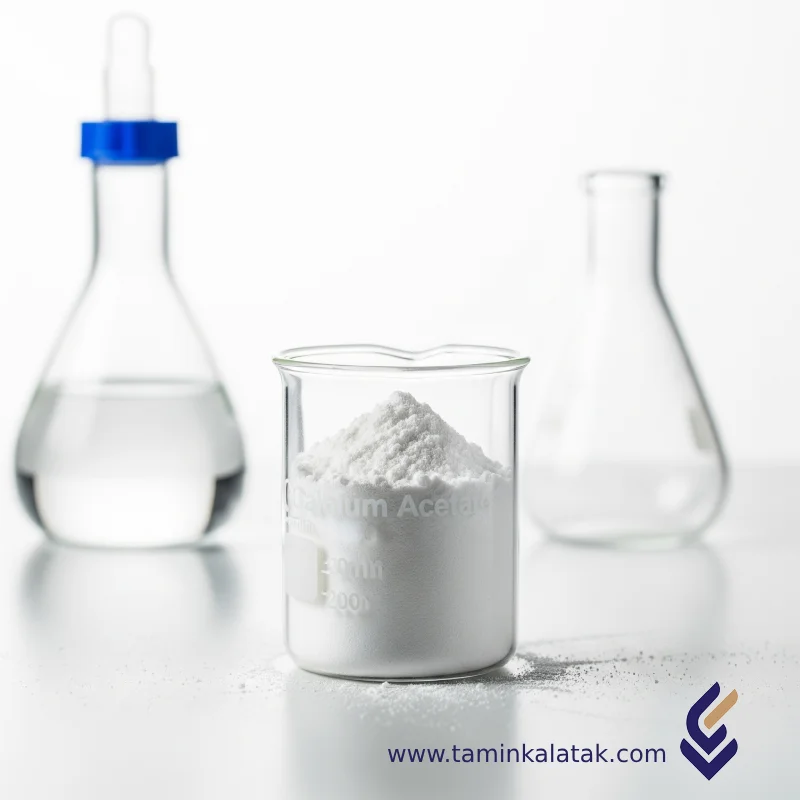
Calcium acetate
Sodium Acetate (CH₃COONa) is the sodium salt of acetic acid. It appears as a white crystalline powder, either odorless or with a faint vinegar-like smell (especially when heated). Sodium acetate is slightly hygroscopic, particularly in its anhydrous form, and exists in two common forms:
-
Anhydrous (dry) sodium acetate, and
-
Hydrated sodium acetate, typically the trihydrate form (CH₃COONa·3H₂O).
Chemical Structure of Sodium Acetate
Sodium acetate is an ionic compound composed of a sodium cation (Na⁺) and an acetate anion (CH₃COO⁻).
The acetate ion contains a methyl group (CH₃) bonded to a carboxylate group (COO⁻). Within the carboxylate group, the double bond between carbon and oxygen exhibits resonance, meaning the negative charge is delocalized over both oxygen atoms.
Chemical formula: CH₃COONa
Resonance structure: O=C–O⁻ ↔ ⁻O–C=O
Properties of Sodium Acetate
| Property | Description |
|---|---|
| Appearance | White crystalline powder |
| Odor | Odorless; may emit a vinegar-like smell when heated |
| Solubility | Highly soluble in water; slightly soluble in ethanol (~1.4 g/100 mL) |
| Hygroscopicity | The anhydrous form absorbs moisture from air |
| pH Nature | A salt of a weak acid (acetic acid) and a strong base (NaOH); aqueous solutions are slightly basic (pH 8–9 for 0.1 M solution) |
| Melting Point | Anhydrous: decomposes around 324°C; Trihydrate: melts at ~58°C, releasing its water of crystallization |
| Buffer Capacity | Forms a buffer with acetic acid, effective in pH range 4.0–6.5 |
| Chemical Behavior | Can release acetic acid or CO₂ upon contact with strong acids or oxidizing agents |
Applications of Sodium Acetate
1. Food Industry
-
Used as a food additive (E262) for pH control, flavoring (salty/sour), and preservation.
-
Exhibits antibacterial and antifungal properties in certain food formulations.
2. Pharmaceutical and Medical Applications
-
Used as a source of sodium in IV infusions and dialysis solutions.
-
Functions as a buffering agent in pharmaceutical formulations and biological reactions.
3. Textile Industry
-
Serves as a dyeing assistant and pH regulator in dye baths.
-
Neutralizes residual acids such as sulfuric acid (H₂SO₄).
-
Helps prevent static electricity on fabrics.
4. Construction Industry
-
Used as an additive in concrete to control pH and improve frost resistance (acts as a sealing agent).
5. Laboratory Applications
-
Widely used in buffer preparation (especially in biochemistry and DNA extraction).
-
Acts as a carbon source for bacterial cultures.
-
Included in extraction and purification solutions in molecular biology.
6. Hand Warmers and Heat Packs
-
In supersaturated sodium acetate trihydrate solutions, rapid crystallization releases latent heat (approximately 264–289 kJ/kg)—used in reusable heating pads.
7. Other Industrial Uses
-
Rubber industry: delays vulcanization of chloroprene.
-
Leather tanning and dye production: acts as a process regulator.
Advantages of Sodium Acetate
✅ FDA-approved as safe for food use (within regulated limits)
✅ Effective buffering properties
✅ High compatibility with industrial processes
✅ Low cost and readily available
✅ Exhibits antimicrobial and preservative effects
✅ Useful in phase-change thermal systems
Disadvantages of Sodium Acetate
⚠️ Hygroscopic (especially the anhydrous form) — requires sealed storage
⚠️ Irritating to eyes and skin upon contact
⚠️ Inhalation of dust may cause respiratory irritation
⚠️ Ingestion in excess may lead to gastrointestinal discomfort or hypernatremia
⚠️ Decomposes at high temperatures, releasing irritating vapors
⚠️ Should be used with caution in renal or cardiac patients due to electrolyte effects
⚠️ Some pharmaceutical forms may contain aluminum or other excipients, requiring special care in premature infants or renal patients
Applications
| Applications | , , , |
|---|
Calcium acetate
| Products | Formula | Molecular weight | Melting point | Bulk Density | pH (aqueous solution) | Main applications |
|---|---|---|---|---|---|---|
| Calcium diacetate | C4H6CaO4 | 15.817,00 | It decomposes. | Varies depending on particle shape and size, typically in the range of 0.5−0.8cm3g | About 7.5 to 8.2 (depending on concentration) | - Food additive (E263) as a preservative or stabilizer - Pharmaceuticals (as a phosphate binder in dialysis patients) - Production of biopolymers - Production of plaster |


